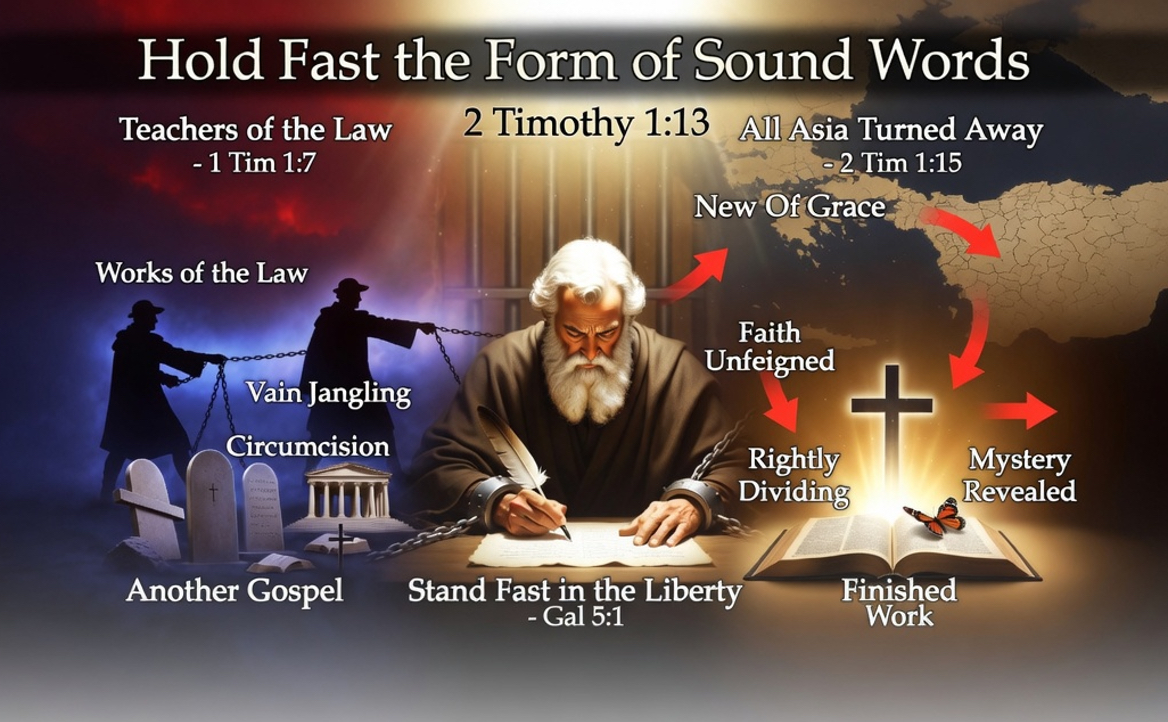
Have you ever stopped to ask yourself why the Apostle Paul spent so much ink warning the churches about certain men who “desired to be teachers of the law”? (1 Timothy 1:7 KJV). Or why he pleaded with the Ephesian elders to watch out for “grievous wolves” and men “of your own selves” who would “draw away disciples after them”? (Acts 20:29-30 KJV). These weren’t minor side issues for Paul. They struck at the very heart of the gospel of the grace of Christ that had been committed to him for us Gentiles.
Let’s rightly divide this together. We’ll look first at the teachers of the law that troubled Paul’s ministry in his own day, then at those who sought to draw away disciples after themselves, and finally at the historical evidence of how the so-called “church fathers” departed from Paul’s pure doctrine of grace. We’ll also see, by God’s grace, that the truth of salvation by faith in the finished work of Christ apart from any works has never been completely silenced—though it has often been buried under layers of religious tradition.
Paul’s Clear Warnings: Teachers of the Law Who “Understand Neither What They Say”
Paul didn’t mince words when he described the problem in his first letter to Timothy:
“Now the end of the commandment is charity out of a pure heart, and of a good conscience, and of faith unfeigned: From which some having swerved have turned aside unto vain jangling; Desiring to be teachers of the law; understanding neither what they say, nor whereof they affirm.” (1 Timothy 1:5-7 KJV)
These men weren’t outright atheists or pagans. They were religious. They wanted the title “teacher.” They wanted to sound spiritual. But they had “swerved” from faith unfeigned—real, genuine faith that comes by hearing the word of God rightly divided (Romans 10:17 KJV). Instead they turned to “vain jangling”—empty noise, religious chatter that sounds impressive but profits nothing.
Think about that for a moment. Paul says their problem wasn’t ignorance of the law itself. The law is holy and good when used lawfully (1 Timothy 1:8 KJV). Their problem was they didn’t understand the purpose of the law in this present dispensation of grace. They were trying to mix the law (given to Israel for a different program) with the grace that had been revealed to Paul for the Body of Christ.
We see this exact same crowd showing up in Galatia:
“O foolish Galatians, who hath bewitched you, that ye should not obey the truth, before whose eyes Jesus Christ hath been evidently set forth, crucified among you? This only would I learn of you, Received ye the Spirit by the works of the law, or by the hearing of faith?” (Galatians 3:1-2 KJV)
These teachers of the law insisted that Gentile believers had to be circumcised and keep the law of Moses in order to be “complete” or to stay in good standing with God. Paul called it another gospel—which is not another (Galatians 1:6-7 KJV). They were turning the Galatians away from the “hearing of faith” that had ministered the Spirit to them and back to the “works of the law” that could never justify anyone.
Paul’s frustration is palpable because he had already given them the clear Pauline truth:
“Knowing that a man is not justified by the works of the law, but by the faith of Jesus Christ, even we have believed in Jesus Christ, that we might be justified by the faith of Christ, and not by the works of the law: for by the works of the law shall no flesh be justified.” (Galatians 2:16 KJV)
The teachers of the law were not content to let the finished work of Christ stand alone. They wanted to add something—anything—that would allow the flesh to boast. And Paul knew exactly where that road led: back into bondage (Galatians 5:1 KJV).
When you hear someone say a believer must “repent of sins,” “get water baptized to complete salvation,” “keep the commandments to stay saved,” or “confess sins daily to stay in fellowship,” what are they really doing? They are echoing the same teachers of the law that plagued Paul’s ministry.
Those Who “Draw Away Disciples After Themselves”
Paul didn’t just warn about false doctrine—he warned about the motive behind it. In his farewell to the Ephesian elders he said:
“For I know this, that after my departing shall grievous wolves enter in among you, not sparing the flock. Also of your own selves shall men arise, speaking perverse things, to draw away disciples after them.” (Acts 20:29-30 KJV)
Notice the progression. First, grievous wolves from outside come in. Then, men of your own selves rise up. Both groups have the same goal: to draw disciples after themselves rather than after Christ and the truth of His grace revealed through Paul.
These men weren’t content to point people to the Apostle Paul’s epistles as the final authority for the Body of Christ in this dispensation. They wanted followers who looked to them for spiritual guidance. They wanted to be the ones “rightly dividing” for everyone else. They wanted the praise of men.
Paul had already seen this tactic in Galatia and Corinth. The Judaizers didn’t just teach a little law—they sought to undermine Paul’s apostleship itself so the Galatians would follow them instead. :
“They zealously affect you, but not well; yea, they would exclude you, that ye might affect them.”. (Galatians 4:17 KJV)
This is why Paul repeatedly magnified his office and reminded the churches:
“For I speak to you Gentiles, inasmuch as I am the apostle of the Gentiles, I magnify mine office.” (Romans 11:13 KJV)
“If any man think himself to be a prophet, or spiritual, let him acknowledge that the things that I write unto you are the commandments of the Lord.” (1 Corinthians 14:37 KJV)
The spiritual purpose here is clear: God wants us grounded and settled in the hope of the gospel (Colossians 1:23 KJV) that Paul preached—not tossed about by every new teacher who claims special insight.
The Forsaking in Asia: “All They Which Are in Asia Be Turned Away from Me”
One of the most heartbreaking statements in all of Paul’s writings comes near the end of his ministry. Writing from a Roman prison, facing death, the Apostle to the Gentiles told Timothy:
“This thou knowest, that all they which are in Asia be turned away from me; of whom are Phygellus and Hermogenes.” (2 Timothy 1:15 KJV)
All Asia. Not some. Not a few stragglers. The very region where Paul had labored so intensely—Ephesus, Colossae, Galatia, and beyond—had largely turned away from him. Have you ever paused to consider how painful that must have been? The man who had poured out his life for the churches, who had warned them night and day with tears (Acts 20:31 KJV), now sat largely abandoned by those he had begotten in the gospel.
This wasn’t just personal rejection. In the context of right division, it was a doctrinal forsaking. Paul had delivered to them the revelation of the mystery, the gospel of the grace of Christ, the truth that believers are complete in Him, forgiven of all trespasses, and standing in unmerited favor. Yet many in Asia turned back toward the familiar—law, works, rituals, or the teachings of the circumcision party. They chose the comfort of religious performance over the liberty of the new creature in Christ.
Look at the company Paul mentions: Phygellus and Hermogenes. We don’t know much about them, but their names are preserved in Scripture as examples of those who turned away. Later in the same letter Paul names others:
“Demas hath forsaken me, having loved this present world, and is departed unto Thessalonica; Crescens to Galatia, Titus unto Dalmatia. Only Luke is with me.” (2 Timothy 4:10-11 KJV)
Demas didn’t just leave Paul—he loved this present world. That pull is still strong today, isn’t it? The desire for acceptance, for visible “success,” for a gospel that mixes a little law with grace so it feels more “balanced” or respectable. Paul had already seen the seeds of this in his earlier warnings:
“For I know this, that after my departing shall grievous wolves enter in among you, not sparing the flock. Also of your own selves shall men arise, speaking perverse things, to draw away disciples after them.” (Acts 20:29-30 KJV)
The forsaking in Asia was the fruit of exactly what Paul had prophesied. Men rose up from within, drawing disciples after themselves instead of grounding them in the Pauline revelation. They likely taught a blended message—some of Paul’s words mixed with kingdom truths meant for Israel, or works added to “perfect” what grace had begun. Sound familiar?
This is why Paul urged Timothy so strongly:
“Hold fast the form of sound words, which thou hast heard of me, in faith and love which is in Christ Jesus. … Study to shew thyself approved unto God, a workman that needeth not to be ashamed, rightly dividing the word of truth.” (2 Timothy 1:13; 2:15 KJV)
Timothy was to continue in the things he had learned from Paul, not from the popular teachers in Asia. The spiritual purpose here is crystal clear: when the majority turns away from Pauline doctrine, the faithful remnant must cling tighter to what was delivered by the Apostle to the Gentiles.
If “all Asia” forsook Paul in his own lifetime, should we be surprised when large segments of professing Christianity today prefer a blended, works-tinged message over the pure grace of the mystery? The pressure to conform is real—but Paul’s example calls us to stand anyway.
This early forsaking was the beginning of the broader historical departure we see in the so-called church fathers. The institutional church quickly moved away from the “faith unfeigned” and the “hearing of faith” that ministers the Spirit. Yet God preserved Paul’s epistles so that in every generation a remnant could recover the truth: we are justified by the faith of Christ, not our own efforts; forgiven of all trespasses; new creatures who stand complete in Him.
Don’t let the forsaking of Asia discourage you. Paul kept preaching the gospel of grace even when almost everyone turned away. He finished his course with joy because his confidence was not in men, but in the Lord who stood with him (2 Timothy 4:17 KJV).
May we have the same resolve: to hold fast the pattern of sound words we received from Paul, rightly divide the word of truth, and refuse to be moved away from the hope of the gospel. Grace and peace be multiplied unto you through the knowledge of God and of Jesus our Lord.
Satan Transformed as an Angel of Light: His Ministers and the Departure from Paul’s Doctrine
Paul wasn’t just dealing with sincere but mistaken religious men. He saw something far more sinister at work. In his second letter to the Corinthians he pulls back the curtain:
“For such are false apostles, deceitful workers, transforming themselves into the apostles of Christ. And no marvel; for Satan himself is transformed into an angel of light. Therefore it is no great thing if his ministers also be transformed as the ministers of righteousness; whose end shall be according to their works.” (2 Corinthians 11:13-15 KJV)
Ministers of righteousness. That’s the key. These weren’t obvious pagans or atheists. They looked spiritual. They talked about righteousness, holiness, and serving God. They probably quoted Scripture and appeared to have a form of godliness. Yet they were tools in Satan’s hand to undermine the pure gospel of the grace of Christ that Paul had delivered.
Tie this straight to the teachers of the law we’ve been studying. The Judaizers in Galatia didn’t come in saying “We hate Jesus.” They came saying, “Jesus is great—but you also need to keep the law, be circumcised, and do these works to be accepted or to stay right with God.” They transformed themselves into ministers of righteousness—but it was a righteousness that mixed law with grace and robbed the cross of its glory.
The same spirit operated in Asia. When “all they which are in Asia be turned away from me” (2 Timothy 1:15 KJV), it wasn’t random. It was the result of false apostles and deceitful workers who presented a more “balanced” or “practical” message. Satan doesn’t need to deny Christ outright. He just needs to add a little “and” to the gospel: “faith in Christ and works… grace and law… the mystery and the earthly kingdom program.”
Have you ever noticed how the most dangerous errors in professing Christianity today come wrapped in the language of righteousness, holiness, and “deeper commitment”? They sound so spiritual—yet they subtly move people away from resting in the finished work of Christ and back under performance. That is exactly the strategy Paul exposed.
This is why Paul emphasized his own apostleship so strongly. He wasn’t being arrogant; he was protecting the revelation of the mystery from being corrupted by these transformed ministers:
“But I certify you, brethren, that the gospel which was preached of me is not after man. For I neither received it of man, neither was I taught it, but by the revelation of Jesus Christ.” (Galatians 1:11-12 KJV)
When the churches in Asia turned away, they weren’t just rejecting Paul the man—they were turning from the distinctive truths Christ gave him for this dispensation. Satan’s ministers had done their work well. They appeared as “ministers of righteousness,” but they were leading people back into bondage.
This same pattern continued into the early “church fathers” and beyond. Many spoke beautifully of Christ while mixing in works, rituals, and law-keeping. They transformed themselves into something that looked right—but it departed from the “form of sound words” Paul delivered (2 Timothy 1:13 KJV).
The spiritual purpose for us today is crystal clear. We must test every teaching, every “minister of righteousness,” by whether it exalts the finished work of Christ and the pure grace revealed to Paul, or whether it subtly adds something to it. Satan is still transforming himself and his ministers. The only safeguard is to rightly divide the word of truth and hold fast to Paul’s gospel.
Stand fast. The light Paul preached still shines. Don’t let the transformed ministers of righteousness draw you away from the liberty we have in Christ Jesus. Grace and peace be multiplied to you through the knowledge of our Lord.
Historical Evidence: The So-Called Church Fathers Depart from Paul’s Doctrine
It didn’t take long after Paul’s departure for the very thing he warned about to happen. The so-called “church fathers” of the second and third centuries began mixing law and grace, adding works and rituals, and elevating church hierarchy over the simple truth of the mystery revealed to Paul.
Consider a few examples (drawn from their own writings, which Mid-Acts believers have long studied to see the early departure):
- Ignatius of Antioch (c. 35–107 AD) wrote letters that emphasized obedience to the bishop as essential to salvation and unity. He urged believers to “do all things in the name of the Lord” while tying that to external religious order and works. This is a far cry from Paul’s declaration that “in Christ Jesus neither circumcision availeth any thing, nor uncircumcision, but a new creature” (Galatians 6:15 KJV).
- Clement of Rome (c. 96 AD) in his letter to the Corinthians stressed works of righteousness and the importance of “good deeds” alongside faith. While he quoted some Pauline language, he blended it with Old Testament law-keeping patterns in a way Paul never did.
- By the time of Justin Martyr (c. 100–165 AD) and especially Tertullian and Augustine (354–430 AD), the slide was complete. Augustine’s influence helped solidify infant baptism, sacramental grace, and the idea that ongoing works and church rituals were necessary to “maintain” justification. The pure Pauline truth—that God hath already “forgiven you all trespasses” (Colossians 2:13 KJV) and “will not impute sin” (Romans 4:8 KJV)—was buried under layers of religious performance.
These men were not malicious in every case. Many professed to loved the Lord. But they failed to rightly divide the word of truth. They treated Paul’s epistles as one voice among many instead of the final revelation of the mystery for this age of grace. The result? The institutional church moved further and further from the “faith unfeigned” Paul defended and closer to the “vain jangling” he condemned.
If Paul were writing a letter to the church in 2026, would he sound any different than he did to Timothy and the Galatians? The same spirit of “teachers of the law” is alive and well today—only now they wear different labels.
Voices That Echoed the Pure Grace of Christ Apart from Works
Thankfully, the truth of salvation by grace through faith in the finished work of Christ—apart from any works—has never been entirely lost. While the institutional “church” departed early, God has always preserved small groups who have clung to Paul’s gospel.
In the writings of some early believers we still catch glimpses. For example, certain statements by Chrysostom (c. 347–407 AD) on justification by faith show flashes of Pauline clarity, even if mixed with other elements.
During the Reformation, Martin Luther recovered the truth of “justification by faith alone” from Romans and Galatians, striking a blow against the works-righteousness of Rome. While Luther still retained some traditions (like infant baptism), his stand on Romans 3-5 and Galatians 2-3 echoed Paul’s cry that a man is justified “by the faith of Christ” (Galatians 2:16 KJV).
Later, men like John Nelson Darby, E.W. Bullinger, and others in the 19th and 20th centuries began to see the full dispensational distinction of the mystery and the preeminence of Paul’s gospel for the Body of Christ. They taught salvation as the free gift of God received by faith alone in the finished work of the cross—no water baptism, no law-keeping, no ongoing performance required to “stay saved.”
Even today, through the grace of God, believers who study Paul’s thirteen epistles with a heart to rightly divide find the same liberating truth: “For by grace are ye saved through faith; and that not of yourselves: it is the gift of God: Not of works, lest any man should boast” (Ephesians 2:8-9 KJV).
The spiritual purpose? To keep us from being “moved away from the hope of the gospel” (Colossians 1:23 KJV) and to present every man perfect in Christ Jesus (Colossians 1:28 KJV).
Standing Fast in the Liberty Wherewith Christ Hath Made Us Free
The teachers of the law are still with us. They still desire to bring us back under the yoke of bondage. They still seek to draw disciples after themselves rather than pointing us to the Apostle Paul’s clear instructions for this present age.
But we have been given the same charge Paul gave Timothy:
“Continue thou in the things which thou hast learned and hast been assured of, knowing of whom thou hast learned them.” (2 Timothy 3:14 KJV)
And the same glorious promise:
“Stand fast therefore in the liberty wherewith Christ hath made us free, and be not entangled again with the yoke of bondage.” (Galatians 5:1 KJV)
Will you believe what Christ revealed to Paul for the Body of Christ? Will you trust that your sins are already forgiven, your trespasses are not imputed, and you stand complete in Him? That is the “hearing of faith” that still ministers the Spirit today.
May the Lord give us all grace to hold the mystery of the faith in a pure conscience (1 Timothy 3:9 KJV) and to keep pointing others to the Apostle Paul’s gospel—the power of God unto salvation to everyone that believeth.
© 2026 Edward R. Cross